Key Takeaways
- UX design: shapes how visitors interact with a website, covering usability, accessibility, visual design, and emotion.
- Business impact: Poor UX costs businesses real money through higher bounce rates, wasted ad spend, and leads lost to competitors with easier-to-navigate sites.
- UX vs UI: UX focuses on the overall experience and blueprint, while UI focuses on the visual interface elements users interact with.
- The process: Successful UX follows three core stages: research and analysis, wireframing and prototyping, and usability testing.
- Investment ROI: Investing in UX improves customer satisfaction, reduces long-term development costs, and increases conversion rates.
Introduction
User experience (UX) is the process of creating products that provide meaningful and relevant experiences to users, and it has a direct impact on how your business performs online.
What is UX design, exactly? At its core, UX design considers how a user interacts with a product and evaluates how easy it is for them to use.
Understanding UX design meaning goes beyond aesthetics: it covers the full journey a visitor takes on your website, from the moment they land to the moment they convert (or leave). Businesses that grasp this perform better, not because they have fancier websites, but because they understand what their customers need.
The Basics of UX Web Design
UX web design focuses on the interaction between the user and the product or service they are using. This includes factors such as visual design, usability, accessibility, and emotions.
UX designers aim to create products that are intuitive, efficient, and enjoyable to use by paying attention to every detail of the user's journey, from what information is displayed on each page to where buttons are placed for the easiest possible navigation. The goal is always to make things as simple as possible for users.
A good UX design process starts long before anything goes live. It's a discipline that sits at the intersection of psychology, design, and business strategy, which is why it matters far more than most businesses initially realise.
The Benefits of UX Design
There are many benefits of investing in user experience design for businesses, both big and small. An optimised user experience improves customer satisfaction levels, which leads to increased sales and stronger brand loyalty over time.
Well-designed products are also more likely to succeed since users won't struggle when trying out new features or navigating through different sections of your website or app, which means they're more likely to stay, engage, and convert.
Beyond that, good UX design can help you save money in the long run since you won't need to spend extra time or resources fixing problems after launch.
Essential Elements of UX Design
Let's look at the core elements of the UX design process that go into creating the best experience for your customers.
Research & Analysis
A great user experience starts with understanding your customer's needs, motivations, and habits. Research and analysis are key components of UX design as they provide an in-depth look at how customers interact with a product or service.
Research can take many forms, from surveys to interviews to usability testing. This research should be used to inform your design decisions, so it's important to think about what type of information you need before beginning the research process.
Wireframing & Prototyping
Once you have a clear picture of your customers, it's time to start designing! Wireframing is the process of creating a visual representation of what the user interface will look like based on research and analysis findings.
A wireframe outlines all major elements, such as navigation menus, buttons, text boxes, etc., so that designers can quickly identify areas that need improvement or additional development. Prototyping is similar to wireframing, but it offers a more interactive version, which allows designers to test out different designs before launching their final product or service.
Some of the best tools for UX design at this stage include Figma, Adobe XD, and InVision, all widely used UX design tools that support both wireframing and prototyping in collaborative environments.
Usability Testing
Usability testing is one of the most important aspects of UX design as it helps ensure that any changes made are in line with user expectations and preferences.
Usability testing involves having actual users navigate through your website or application in order to determine if there are any issues with usability or if any improvements need to be made before launch day.
During this process, designers can also make sure that their product meets all accessibility requirements for those who may have disabilities or other special needs when using it.
Signs Your Website Has a UX Problem (Even If It Looks Good)
A visually polished website doesn't automatically mean a well-functioning one. Many businesses invest in beautiful design and still see poor results — because how a website looks and how it works for users are two different things.
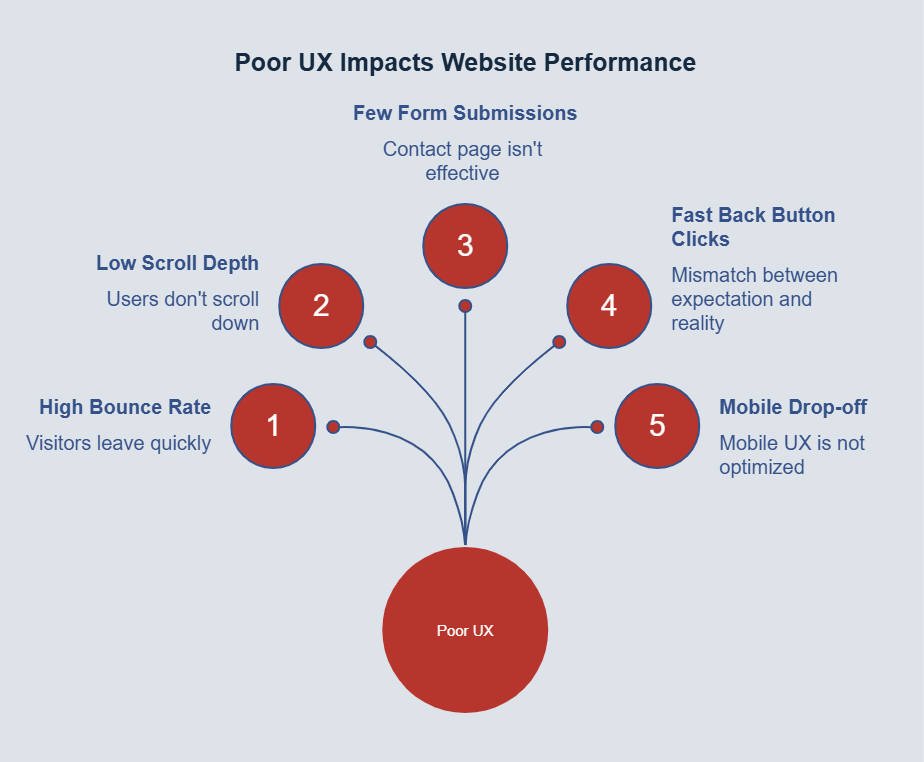 Signs of UX problems in a website
Here are the warning signs to watch for:
- High bounce rate despite decent traffic: If visitors are landing on your site but leaving almost immediately, the page isn't giving them a reason to stay. This is one of the clearest indicators of a UX problem.
- Visitors leaving before scrolling past the fold: If your analytics show users aren't scrolling, your above-the-fold content isn't communicating value fast enough, or the layout is making it hard to know where to look.
- Low form submissions despite traffic to contact pages: Getting visitors to a contact page is one thing. If they're not submitting, the form is likely too long, confusing, or the surrounding content isn't building enough trust to prompt action.
- Users clicking the back button within seconds: A fast exit, especially from mobile, signals a mismatch between what the user expected to find and what the page delivered.
- Mobile visitors dropping off faster than desktop: With the majority of web traffic now coming from mobile devices, a site that isn't optimised for UX mobile design will lose a significant share of potential customers.
What Happens When You Ignore UX? Real Business Consequences?
This is why UX design strategy is important; not just as a design decision, but as a business one. Poor UX doesn't just create a frustrating experience. It has measurable downstream effects on your bottom line:
- Lost leads to competitors: When a visitor can't quickly find what they're looking for on your website, they don't wait; they go to the next result. If a competitor's site makes the same service feel simpler and more trustworthy, that's the business they'll contact.
- Wasted ad spend: Paid traffic only works if the destination converts. Driving visitors to a confusing or friction-heavy website means paying for clicks that go nowhere.
- Damaged brand perception: There's often a gap between how a business sees itself and how its website communicates. A cold or cluttered website actively erodes trust in the brand.
- Higher customer acquisition costs: When your website isn't doing its share of the selling, every other channel has to work harder. A strong UX design strategy makes the website a genuine lead generation asset.
UX Design vs. UI Design: What's the Difference?
User experience (UX) design focuses on the overall journey a user takes through a product; how easy it is to navigate, how logically information is structured, and whether the experience achieves what the user came to do.
User interface (UI) design focuses specifically on the visual elements users interact with: buttons, typography, colour, spacing, and layout.
Think of it this way: UX is the blueprint; UI is the finish. Both matter. A website can be beautifully designed (strong UI) but frustrating to use (weak UX). Best UX design practices bring the two together, ensuring that the experience is both intuitive and well-presented.
UX Design Examples: What Good UX Looks Like in Practice
Understanding UX design in theory is useful. Seeing what it looks like in practice makes it easier to identify what's missing on your own site.
Good UX design examples share a few things in common:
- Clear hierarchy: The most important information is visible without scrolling. Users don't have to hunt.
- Friction-free navigation: Menus are simple. Pages are findable. The path from interest to enquiry is short.
- Mobile-first thinking: Every element is considered for a smaller screen first: tap targets are large enough, and text doesn't require zooming.
- Purposeful calls to action: Every page knows what it wants the user to do next and makes that action easy and obvious.
At Bike Bear, we apply these principles across every web design project we take on, from corporate sites to campaign microsites. If you'd like to see how this translates in real work, explore our portfolio.
The Importance of UX Design for Business Success
User experience should be at the forefront of any business's digital strategy. Companies that invest in UX design will benefit from higher customer satisfaction levels, improved engagement rates, and lower long-term development costs, because well-designed interfaces need fewer fixes after launch.
Whether you're building a new website or reviewing an existing one, the right UX design agency will help you move beyond aesthetics and build a site that actively works for your business goals.
Work with a UX Design Agency That Understands Your Market
If there's one thing our work at Bike Bear consistently shows, it's that the businesses with the best-performing websites aren't always the ones with the biggest budgets; they're the ones who invested in understanding their users first.
If your website isn't converting the way it should, or you're not sure why, get in touch with us, and we'll take a look. No obligation.