


Key Takeaways
- Video ROI extends beyond revenue to include awareness, engagement, conversions, and customer lifetime value — not just immediate sales.
- Define clear objectives before filming and track metrics that match your funnel stage, from views to conversions to retention.
- Avoid common traps: focusing on vanity metrics, neglecting storytelling, ignoring pre-production strategy, and overlooking platform optimisation.
- Production quality affects ROI through strategic storytelling, authenticity, and consistent branding — not just technical polish.
- More views don't equal more value; high budgets don't guarantee results; branding videos can absolutely be measured.
- Strategic partners maximise ROI through planning, data-driven storytelling, and integrated tracking.
Introduction
You know video works. Your social feeds prove it. Customer testimonials confirm it. But when leadership asks for hard numbers — when budgets tighten and every ringgit needs justification — vague answers about "brand awareness" and "engagement" no longer cut it.
The challenge isn't whether video delivers results. It's proving those results in language that resonates with CFOs, investors, and boards.
This article unpacks exactly how to measure video production ROI, cuts through common misconceptions that waste budgets, and shows how strategic storytelling aligns with quantifiable outcomes.
We'll explore the metrics that matter, the pitfalls that trap even experienced marketers, and how Malaysian brands can ensure their creative investments drive sustainable growth.
What Is Video Production ROI (and Why It Matters for Brands)?
Video production is the strategic process of creating visual content that serves specific business objectives — from concept development and scripting through filming, editing, and distribution optimisation.
The ROI of video production measures how effectively that content drives business results relative to its production cost.
But here's what many brands miss: ROI extends far beyond immediate revenue. It encompasses awareness, engagement, conversions, customer retention, and long-term brand loyalty.
For Malaysian brands facing growing scrutiny on creative investments, understanding the ROI for video production transforms how you approach content. It shifts video from a "marketing expense" to a strategic asset, aligns creative teams with business goals, and provides the framework to make smarter decisions about where to invest, what to measure, and how to scale what works.
Also read: What is the Difference Between Video Content Creation and Video Production?
The ROI Formula in Simple Terms
At its core, the formula is straightforward:
ROI = (Revenue Generated – Production Cost) ÷ Production Cost × 100
But applying this to video requires adapting it for both direct and indirect business metrics:
- Lead generation: How many qualified leads did the video produce? What's the cost per lead compared to other channels?
- Sales conversions: How many viewers became customers? What's the conversion rate and average order value?
- Cost per acquisition (CPA): What did it cost to acquire each customer through video versus other marketing channels?
- Brand lift and recall: How much did brand awareness or consideration increase after video campaigns? (Measured through surveys or brand tracking studies)
- Customer lifetime value (CLV): How does video impact customer retention, repeat purchases, and referrals over time?
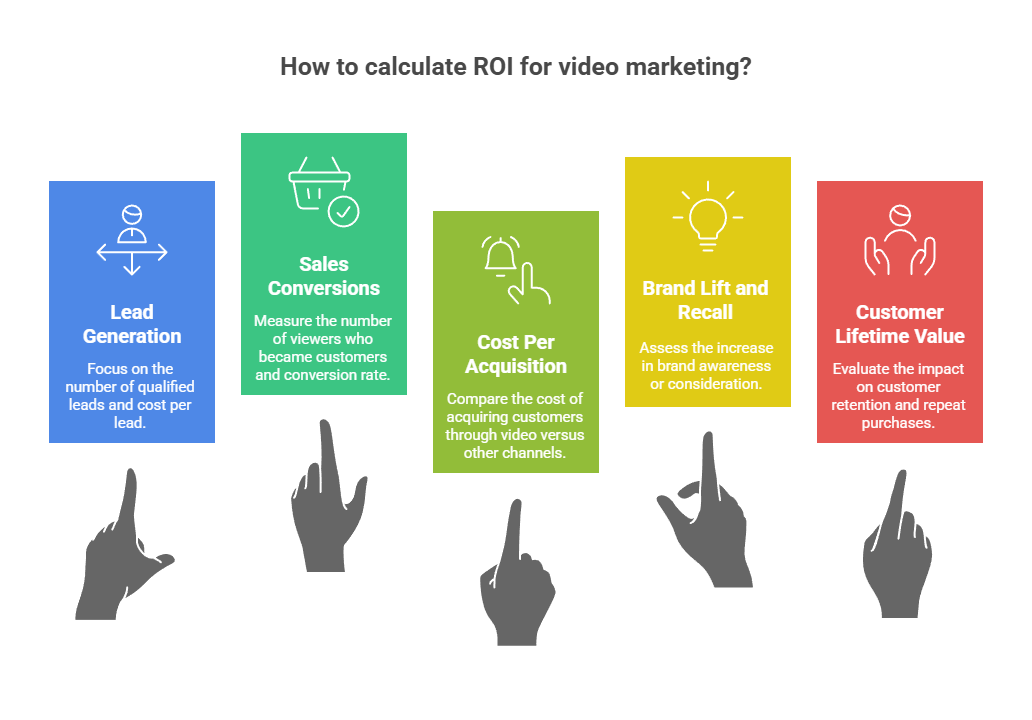
The key is matching your ROI calculation to your video's primary objective. A top-of-funnel awareness video shouldn't be judged solely on immediate sales, just as a product demo video should drive direct conversions.
Why ROI From Video Matters More Than Ever?
The year 2026 brings heightened accountability for creative spending. Leadership teams demand clarity on what every marketing ringgit delivers. Investors scrutinise burn rates.
Boards question soft metrics. In this environment, proving ROI for video production isn't optional — it's essential for securing budgets, defending strategies, and scaling what works.
Malaysian brands face particularly intense pressure. Digital competition has accelerated across Southeast Asia, with more players fighting for the same audience attention.
Local and international brands alike are investing heavily in video content, raising the bar for quality and performance. When everyone's doing video, the brands that win are those who can demonstrate — not just claim — tangible business impact.
Beyond budget justification, understanding the ROI of video production creates organisational alignment. Marketing teams can show how creative work drives the pipeline. Sales teams see how video content shortens deal cycles. Finance understands the customer acquisition economics.
Leadership gains confidence in creative investments. This shared language of measurable outcomes transforms video from a subjective "nice to have" into an objective growth driver that unites stakeholders around common goals.
How Do I Prove ROI for Video Production?
Calculating ROI goes beyond analytics — it starts with aligning creative intent, audience understanding, and measurable goals. The most successful video campaigns don't stumble into results. They're built on strategic foundations that connect every creative decision to a business outcome.
So, what is the ROI of video marketing? It's not a single number—it's a framework that tracks how video content moves audiences through awareness, consideration, and conversion, ultimately delivering measurable business value that justifies and exceeds production investment.
1. Define the Right Objectives
Before cameras roll, clarity matters. Every video needs a defined purpose: Is it driving awareness for a new market segment? Educating prospects about a complex solution? Converting hesitant leads? Retaining existing customers through value-added content?
Not every video needs direct sales impact, but all should serve a measurable role in your marketing ecosystem. A brand manifesto video might not generate immediate leads, but it should measurably increase brand recall or consideration among target audiences.
A product tutorial might not go viral, but it should reduce support tickets or improve activation rates.
The clearer your objective, the easier it becomes to prove ROI for video production. Vague goals produce vague results. Specific objectives enable specific measurement.
2. Track the Right Metrics
Different funnel stages demand different metrics. Here's how to measure ROI for video production across the customer journey:
Top of Funnel (Awareness):
- Views and reach: How many people saw your content?
- Watch completion rate: Are viewers staying engaged through the entire message?
- Share rate: Is your content resonating enough to spread organically?
Middle of Funnel (Engagement):
- Click-through rates: Are viewers taking the next step?
- Watch time: How deeply are audiences engaging with your content?
- Comments and interactions: Is your video sparking conversations?
Bottom of Funnel (Conversion):
- Sign-ups and leads: How many viewers convert to prospects?
- Sales attributed to video: What revenue can be directly traced?
- Cost per lead: How efficient is video compared to other channels?
- ROI percentage: What's the financial return on production investment?
Beyond immediate conversions, the most valuable metrics often measure long-term customer behaviour:
Retention (Long-term Value):
- Repeat purchase rates: Do video-engaged customers buy again?
- Customer lifetime value: Are video audiences more valuable long-term?
- Referral rates: Do engaged customers become advocates?
- User-generated content: Is your video inspiring customer participation?
The most sophisticated marketers track metrics across multiple stages, understanding that a single video often influences the entire funnel.
3. Use Analytics and Tracking Tools
Modern analytics platforms connect creative content directly to business outcomes. Google Analytics tracks how video viewers navigate your site and convert. Meta Pixel reveals which campaigns drive purchases.
YouTube Analytics shows where viewers drop off and what keeps them engaged. CRM integrations tie video touchpoints to deal progression and revenue.
The key is setting up tracking before launch — UTM parameters on video links, conversion pixels on landing pages, event tracking on video players, and lead source attribution in your CRM.
Without proper tracking infrastructure, even the most effective video becomes difficult to measure. Strategic video production partners build tracking into campaign planning from day one, ensuring creative insights inform which metrics matter and performance data shapes future decisions.
Common Mistakes to Avoid When Measuring ROI
Even experienced marketers fall into predictable traps when measuring the ROI for video production:
- Focusing on vanity metrics over conversions: A million views means nothing if none convert to customers. Prioritise metrics that connect to business outcomes — leads, sales, retention — over surface-level engagement.
- Neglecting storytelling in pursuit of technical polish: High production values matter, but not at the expense of clear messaging and emotional connection. A beautifully shot video that confuses audiences is a poor investment.
- Ignoring pre-production strategy: The ROI of video production is largely determined before filming begins. Skipping audience research, message development, and distribution planning is where budgets get wasted.
- Not tracking post-launch results: Without measuring performance and optimising based on insights, you can't prove ROI or improve future campaigns. Post-launch tracking transforms guesswork into a strategic advantage.
- Overlooking platform optimisation: A video optimised for YouTube performs differently on LinkedIn, Instagram, or TikTok. One-size-fits-all distribution leaves ROI on the table.
Avoiding these pitfalls ensures your video investment delivers sustainable business growth rather than short-lived engagement spikes that evaporate without lasting impact.
Why Video Production Quality Affects ROI?
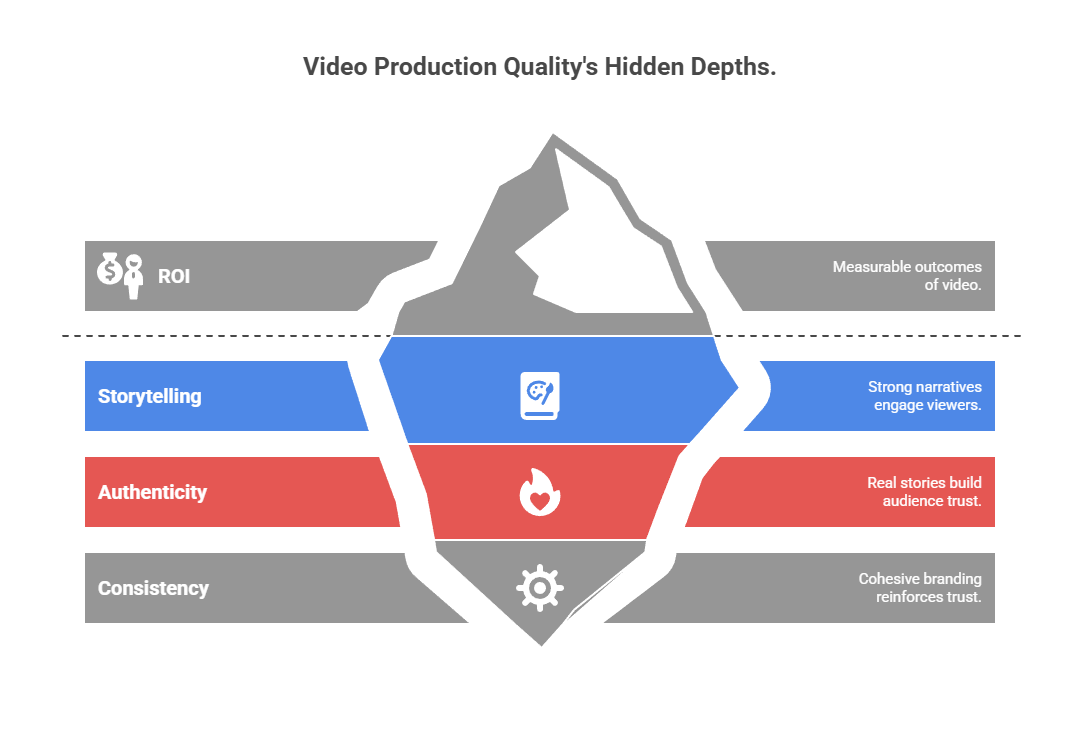
Production quality influences ROI by affecting attention, trust, and brand perception — not just aesthetics. Quality isn't about cinematic polish for its own sake. It's about strategic storytelling, consistent visuals, and audience relevance that drive measurable outcomes.
- Storytelling = Retention: Strong narratives keep viewers engaged and improve recall. When audiences connect emotionally with your story, they remember your brand, understand your message, and take action. Poor storytelling — no matter how well-filmed — fails to convert because it fails to resonate.
- Authenticity Builds Trust: Real, relatable stories outperform over-polished ads. Modern audiences, especially in Malaysia's diverse market, respond to genuine brand voices over corporate perfection. Authenticity doesn't mean low production value — it means alignment between how you present yourself and who you actually are.
- Consistency Drives Conversion: Cohesive branding and tone across all videos reinforce trust and drive loyalty. When your visual identity, messaging, and production standards remain consistent, audiences develop confidence in your brand. Inconsistency creates confusion, weakens recognition, and undermines the ROI of video production by diluting your market position.
Common Misconceptions About Video Production ROI
Misunderstanding how video ROI works leads to poor investment decisions and wasted budgets.
These misconceptions persist across industries, causing brands to chase the wrong metrics, overspend on the wrong elements, or avoid video entirely based on faulty assumptions.
Let's clear up the three most damaging myths:
- "More Views = More Value": Raw view counts are the most misleading metric in video marketing. A video with 10,000 views and a 5% conversion rate delivers far more business value than one with 100,000 views and a 0.1% conversion rate. Engagement depth and conversion actions are better indicators of ROI than vanity metrics that look impressive in reports but don't move revenue.
- "High Budgets Guarantee Results": Spending more doesn't automatically deliver better ROI for video production. Success depends on strategy, message clarity, and audience alignment — not production spend alone. A well-targeted, strategically planned video with a modest budget often outperforms an expensive production with unclear objectives or poor distribution. The investment that matters most happens in pre-production planning, not just on set.
- "ROI Can't Be Measured for Branding Videos": This is perhaps the most damaging misconception. Branding videos drive long-term ROI through brand equity and customer lifetime value. Brand recall studies, consideration metrics, and tracking how brand-engaged customers behave over time all provide measurable proof of impact. The measurement window is longer, but the business value is real and often compounds more powerfully than direct-response content.
How Strategic Partners Like Bike Bear Increase Video Production ROI?
Expert video production companies help brands prove ROI for video production through three critical capabilities that most internal teams lack the bandwidth or expertise to execute consistently:
1. Strategy-Led Creative Planning:
Before any creative work begins, defining audience, KPIs, and creative direction ensures every production decision serves a measurable purpose. This means researching audience behaviour, mapping content to funnel stages, and establishing success metrics that align with business goals — not just creative preferences.
2. Data-Driven Storytelling:
Combining data insights with creative frameworks ensures content performs, not just impresses. Understanding what resonates with Malaysian audiences, which narratives drive action, and how emotional triggers translate to conversions transforms storytelling from subjective art into strategic science.
3. Integrated Campaign Tracking:
Measuring success across platforms, reporting outcomes, and optimising for ROI requires technical infrastructure and analytical expertise. Strategic partners implement tracking systems, interpret performance data, and translate insights into actionable recommendations that improve future campaigns.
Looking for the right fit? Dive deeper: Choosing the Right Video Production Partner for Your Brand in Malaysia
Why Bike Bear Stands Out
At Bike Bear, we ground creative excellence in business understanding. Our deep insight into Malaysian audiences and digital behaviour informs every strategic decision we make.
We maintain a transparent process with clear ROI tracking and performance reports that connect creative work to business outcomes.
Our content combines emotion with measurable results — because we believe the best video production doesn't force you to choose between compelling storytelling and quantifiable impact. When creative strategy and performance measurement work together, that's where sustainable ROI lives.
Ready to see how strategic video drives results? Explore our approach: Video Production & Content Marketing.
FAQs
- How long does it take to see ROI from video production? Top-of-funnel videos show awareness metrics within days, while conversion and retention metrics typically materialise over 3-6 months. Brand equity and customer lifetime value compound over the years.
- What's a good ROI benchmark for video marketing? Industry standards vary by objective and industry, but well-executed campaigns typically achieve 3:1 to 5:1 ROI within the first year. Strategic video assets continue delivering returns long after initial publication.
- Can small budgets still deliver strong video ROI? Absolutely. ROI depends more on strategy, message clarity, and audience alignment than production spend. A well-targeted video with a modest budget often outperforms expensive productions with unclear objectives.
Conclusion
ROI-driven video production connects creativity, strategy, and measurable outcomes. It transforms video from a line-item expense into a strategic asset that justifies its investment, informs smarter decision-making, and scales what works across your marketing ecosystem.
Here's what matters most: video is a long-term asset that compounds in value. A well-produced brand story doesn't just drive results today — it continues working for months or years, building equity with every view.
A product explainer doesn't just convert the first audience — it educates prospects around the clock, reducing sales friction and shortening deal cycles indefinitely.
For Malaysian CMOs and founders navigating competitive markets and budget scrutiny, understanding how to prove ROI for video production isn't just about defending creative spend.
It's about unlocking one of the most powerful growth levers available to modern brands. When video production is grounded in strategy, measured with precision, and optimised continuously, it delivers returns that few other marketing investments can match.
At Bike Bear, we position ourselves as your strategic creative partner focused on measurable success — because we know that proving ROI for video production is what turns sceptical stakeholders into advocates and one-time projects into long-term partnerships.
Discover how our video production strategy helps brands prove real ROI — not just impressions. Let's talk results. Get in touch with Bike Bear today.