

Key Takeaways
- Corporate video production helps businesses communicate visually through storytelling, brand messaging, product explanations, and audience engagement.
- Corporate videos differ from traditional advertisements by focusing more on trust, education, company culture, and long-term brand perception.
- Businesses invest in corporate videos to improve brand awareness, engagement, recruitment, SEO signals, and conversion rates.
- Different corporate video types serve different goals, including company profile videos, testimonial videos, explainer videos, employer branding videos, and event videos.
- A successful corporate video requires clear messaging, professional production quality, strong branding, audience-focused storytelling, and concise delivery.
- Corporate video production involves several stages, including strategy, scripting, filming, editing, motion graphics, sound design, and final optimisation for different platforms.
Introduction
Video is now the king of online content. Malaysian businesses need video to grow. Videos can simplify complex products or services, humanise a brand, and strengthen customer trust.
In fact, video often drives higher engagement, stronger brand recall, and better conversion rates than other formats. However, many don't know where to start. This exploratory guide seeks to explain corporate video production, why it matters, and how to do it right.
What Is Corporate Video Production?
Corporate video production is the methodical process of planning, filming, and editing video content explicitly for business purposes. For instance, marketing, internal communication, training, and brand storytelling.
In practice, corporate video production lets companies explain who they are, what they do, and why they matter.
How do corporate videos help businesses communicate visually?
Corporate videos enable enterprises to turn abstract ideas and complex offerings into clear visual stories that are easier to remember than text alone.
For example, on modern websites, high-quality video quickly demonstrates products in action, and humanises the brand with real people and real stories. Thus, driving higher engagement, longer sessions, and better conversion rates.
Also read: Why high-quality video production is essential in modern design.
The difference between corporate videos and traditional advertisements
Traditional advertisements are natively short, highly promotional spots focused on pushing a specific product or offer in a very limited time window.
Corporate videos, by contrast, tend to be longer and more informative. They often focus on the company's mission, culture, processes, or case studies. Principally, they aim to build trust rather than just triggering an immediate purchase.
Why video content matters for modern businesses?
Modern audiences now consume large amounts of video daily. As such, they are more likely to watch, share, and act on video than on text-only content. This consequently makes it one of the most effective formats for awareness, education, and conversion.
What Is Included in Corporate Video Production?
Corporate video production takes several methodical steps from a raw idea to a polished video. Each step adds value to the final product and should be aligned with clear business goals and brand guidelines.
Concept development and strategy
Who is the video for? What do you want them to do? This stage involves the production team clarifying objectives, target audience, key messages, success metrics, and distribution channels.
Scriptwriting and storyboard planning
Every word matters in a short video. Once the concept is approved, a script is written to structure the narrative. In essence, a script ensures you say the right things. A storyboard draws each scene like a comic strip. In practice, it shows you how the video will look before filming, reducing confusion and reshoots later.
Filming and direction
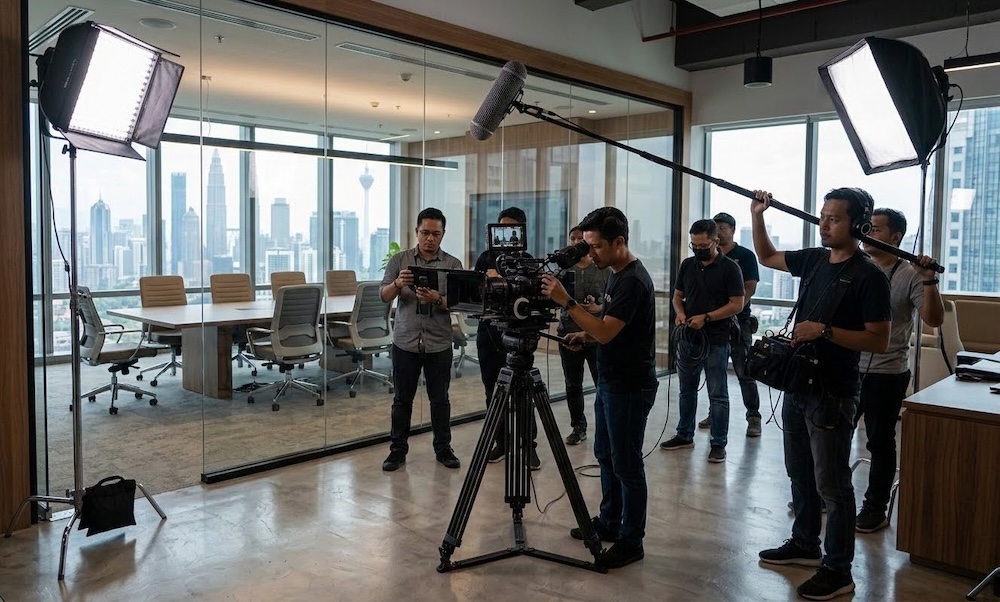
This stage is when the cameras roll. A director guides the actors, interviewees and crew to ensure their delivery matches the brand's tone and script. They also oversee composition, camera movement, and overall visual quality. The filming crew handles lighting, camera setup, audio capture, and performance direction.
Editing, motion graphics, and sound design
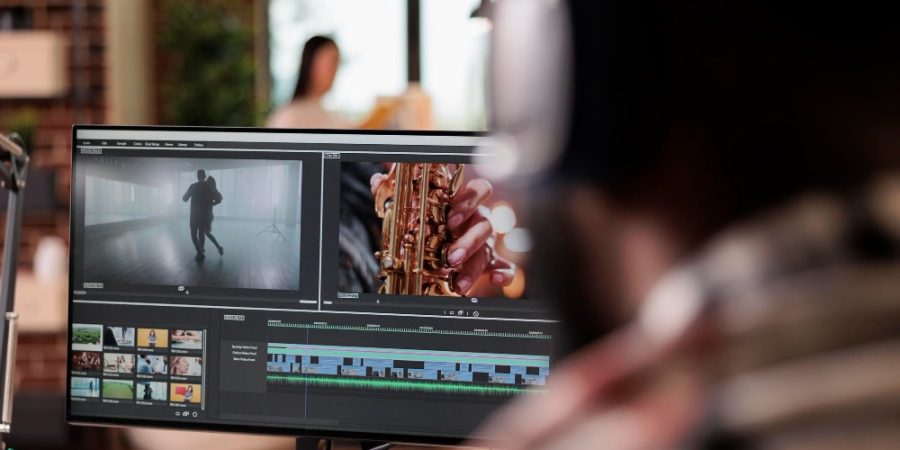
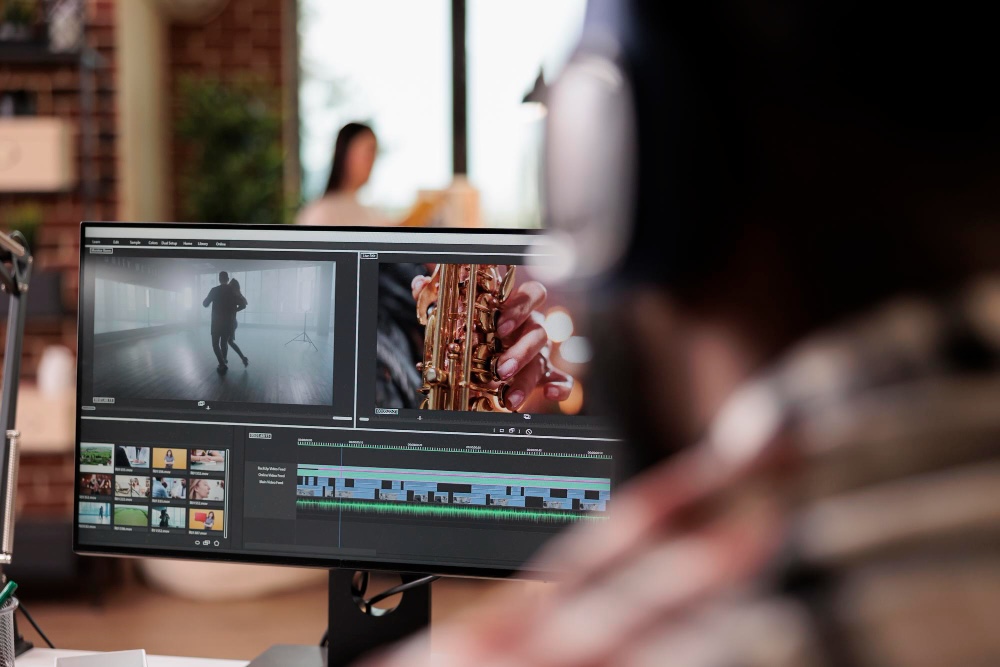
In post-production, editors assemble the best takes, trim for clarity and pacing, and shape the story. Motion graphics, titles, lower thirds, logo animations, and product callouts are also added to reinforce branding. Sound design adds music and fixes audio, making it ready for export in the right formats.
Why Malaysian Businesses Invest in Corporate Video Production?
Businesses utilising strong video assets often enjoy longer dwell times, higher conversion rates, and stronger SEO signals. Here are more reasons why Malaysian businesses are increasingly opting to invest in corporate video production:
- Building brand awareness and trust: People buy from brands they know and like. Videos show your face, your team, and your values. This personal touch builds real trust over time.
- Explaining products and services clearly: Some products are relatively hard to describe with words. A short explanatory video can illustrate how it works in seconds.
- Improving engagement across websites and social media: Posts with video get more likes, shares, and comments. Most social algorithms push video content to more people. So, your reach grows without paying for ads.
- Supporting recruitment, sales, and internal communication: Great workers want to see your culture before joining. As such, sales teams leverage videos to close deals faster.
Also read:
- How video content strengthens your brand identity across your website.
- Three ways strategic video content drives conversions for Malaysian Businesses.
What Types of Corporate Videos Should a Business Invest In?
Different types of corporate videos work together to introduce your brand, build trust, support recruitment, and move prospects through the buyer journey. Let's explore some, shall we?
- Company Profile Video: This video type tells who you are and what you do. It typically shows your office, your team, and your mission. New customers watch this to decide if they can trust you.
- Testimonial Video: Real people saying nice things about you is gold. These videos act as powerful social proof, reducing doubt and helping prospects feel more confident.
- Brand Video Production: This emotion-driven video type shares your bigger purpose, values, personality, and long-term vision. They are designed to strengthen brand positioning and differentiate you from competitors in a crowded market.
- Product or Service Explainer Videos: These videos show how your product solves a real problem. They often employ a mix of live action, screen capture, or animation.
- Recruitment and Employer Branding Videos: These videos show what it's like to work at your company. They highlight culture, benefits, growth opportunities, and real employee stories to attract better‑matched candidates.
- Event and Corporate Culture Videos: These videos capture conferences, launches, CSR activities, team-building, and behind-the-scenes moments. They aim to give both clients and potential hires a more authentic look at your day-to-day.
What Makes a Good Corporate Video (Best Practices)?
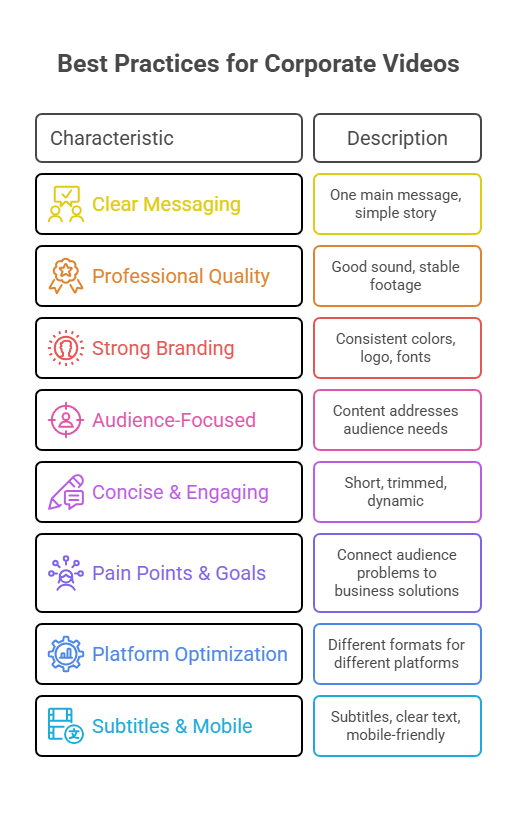
A good corporate video is strategically planned, clearly messaged, well-produced, and tailored to a specific audience and objective. Here are some methodical rules to follow to deliver the best corporate video outcome:
Clear messaging and storytelling
Fundamentally, one video should say one main thing. Do not try to tell your whole history in two minutes. Always pick a single and centralised message and tell a simple story.
Professional visuals and audio quality
Bad sound ruins a good video fast. Dark or shaky footage looks cheap and untrustworthy. So, hire proven professionals who own professional lights, mics, and cameras.
Strong branding and consistency
Utilise your brand colours, logo, and fonts. In fact, aim to keep the same style across all videos. Consistent branding across multiple videos helps reinforce recognition. It also makes each piece feel like part of a coherent, professional ecosystem.
Audience-focused content and CTA
Anchor the content on what your audience cares about. Speak to their problems, not your features. Later, end every video with a clear call to action. Tell them what to do next.
Keep videos concise and engaging.
Attention spans are short, especially online. So, short videos work best. Aim for one to three minutes for most business videos. Trim all fluff, and use pacing, visuals, and editing to keep the story moving.
Focus on audience pain points and business goals.
Before scripting, identify the audience's pain points. After, map them directly to your business goals. Every scene should either highlight a problem they feel or show how your solution improves their life or work.
Optimise videos for websites and social media
Different platforms need different aspect ratios. Square for Instagram. Vertical for TikTok. Horizontal for YouTube. Do not use one version everywhere. Furthermore, compress for fast loading, and use strong thumbnails and titles.
Use subtitles and mobile-friendly formats.
Many viewers in loud environments watch with sound off, especially on mobile. So, subtitles or captions are non-negotiable. Design with small screens in mind, with clear text size, strong contrast, and vertical or square formats where appropriate.
Also read: Video content marketing trends in Malaysia 2026.
How Long Does It Take to Produce a Corporate Video?
The time needed to produce a corporate video can range from a few days to several weeks. However, it largely depends on scope, complexity, and how quickly decisions are made during these phases:
- Pre-production planning and scripting: This first step may take one to three weeks. You write scripts, find locations, and plan shots.
- Filming and production timelines: A one-day shoot covers most short videos. Complex videos with many scenes may take two to three days. Simple studio shoots can finish in half a day.
- Editing, revisions, and final delivery: Editing may take one to four weeks. The editor iteratively cuts the video, adds music, and fixes the colour. You may review and ask for changes. Each round of feedback adds time.
- Other Factors that affect production timelines: Finding actors or filming at busy locations adds delays. Bad weather can push outdoor shoots back.
How much does corporate video production cost in Malaysia?
Corporate video production in Malaysia doesn't have a fixed price. It typically varies based on factors like video length, concept, number of shoot days, and size of crew. Cost might also be determined by whether you need actors, multiple locations, animation, or drone footage.
Also read: Video production ROI: What Malaysian CMOS & Founders need to know.
How to Choose the Right Video Production Company in Malaysia?
As you request quotes from different video production companies in Malaysia, always ensure to:
- Review their portfolio and video style: Do you like their style? Is their existing quality good from start to finish?
- Understand their production process: A good company explains every step before you pay. They send scripts, storyboards, and shot lists.
- Check industry experience and client reviews: Some companies know your industry well. Ask for client names and call them. Better yet, online reviews on Google or Facebook tell the real story.
- Compare timelines, creativity, and pricing: The cheapest option is rarely the best. Look for fair prices, smart ideas, and realistic delivery dates.
Also read: Choosing the right video production partner for your brand.
Conclusion
In summary, corporate video production builds trust, explains products, and boosts sales. In today's fast-moving digital market, a professionally made corporate video is an asset that works for years. It also supports recruitment to sales and internal communication.
Your brand deserves intentional storytelling and professional quality. So, invest in strategic video content that speaks to your audience and drives real results.
Ready to make your first corporate video? Talk to Bike Bear today. We curate professionally produced video content that aligns with your business goals and drives results.