


Key Takeaways
- A bilingual website goes beyond translation; design, navigation, localisation, SEO and content management must work across languages.
- English, BM and Mandarin versions can help Malaysian businesses reach wider audiences and improve the local user experience.
- Design for different text lengths, fonts, CTAs and mobile layouts while keeping navigation and branding consistent.
- Multilingual SEO requires proper hreflang, URL structures and language-specific search intent, not simply translated keywords.
- A structured CMS, localisation workflow and ongoing review help keep every language version accurate and up to date.
Introduction
Malaysia's diverse population speaks Bahasa Malaysia, English, Mandarin, and Tamil. A single-language website ignores this reality. As such, multilingual websites are becoming mission-critical for Malaysian businesses.
Offering information in a customer’s preferred language often improves trust, accessibility and engagement. In fact, building a bilingual or multilingual site is more than translation. It also affects SEO and content management.
Culturally appropriate wording, consistent navigation across versions, language-specific sitemaps and correctly implemented hreflang signals all matter. Getting these elements right opens new markets while getting them wrong hurts your search rankings.
What is a Bilingual Website?
A bilingual website is essentially a single website that delivers its content and core functions in two languages. Thereby, allowing visitors to select the language they understand most comfortably.
In practice, a bilingual website should not translate only selected pages or display occasional phrases in another language. It should consider local terminology, page layout, forms, images, and search-engine requirements. The idea is that each language version remains accurate, accessible and discoverable.
Why Build a Bilingual or Multilingual Website in Malaysia?
Businesses in Malaysia gain clear advantages from a multilingual website.
Reach a wider audience
An English-only site serves part of the market. In Malaysia, nearly every industry has customers using Bahasa Malaysia or Mandarin. Adding a language opens an entirely new pool of searches by targeting language-specific terms. This consequently allows one to reach new customer segments their current site never could.
Improve user experience for local customers
People feel more comfortable in their own language. Almost 73% of consumers prefer to buy from websites in their language. In essence, they trust information they can read clearly. A multilingual site removes the friction of translation, cultivating user trust.
Support regional growth across Malaysia and Singapore
A bilingual site helps one to flexibly expand regionally whilst positioning their brand as accessible and local. Thereby, serving as a practical starting point for businesses seeking customers across different Malaysian states.
What Should You Consider When Designing a Bilingual Website?
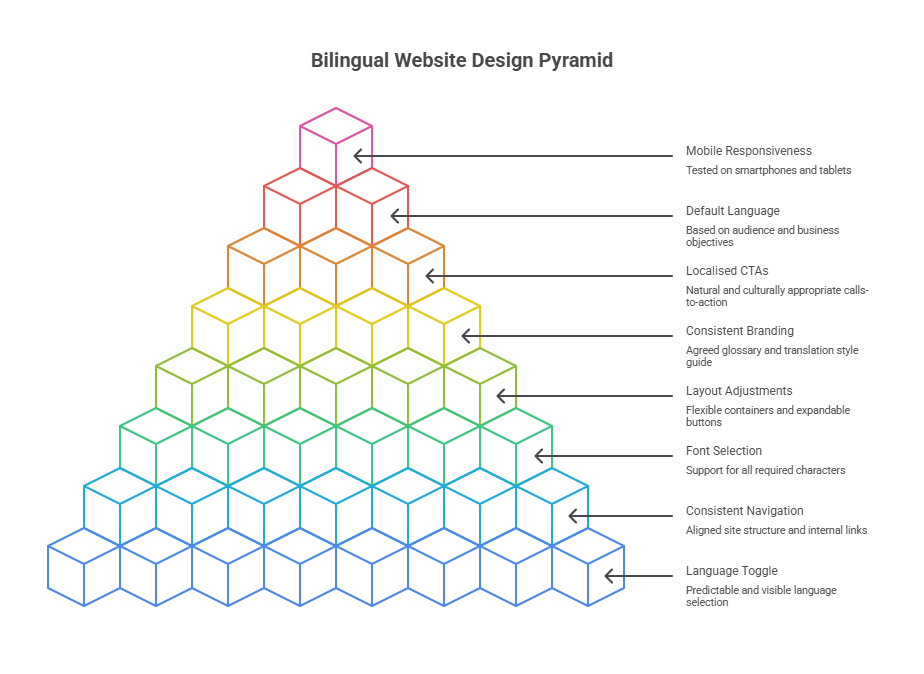
Bilingual Website Design Considerations
Designing a multilingual site requires strategic and careful planning. Here is what to consider to achieve a consistent brand experience in every language:
1. Language toggle placement and usability
Always place the language toggle in a predictable, highly visible location. For instance, the top-right area of the header or within the main navigation. Furthermore, label languages clearly. In fact, don’t use flags to represent languages. This is because some countries have similar flags.
2. Navigation and consistent user journeys across all languages
Users should be able to follow the same basic journey in either language. To that end, the site structure, page hierarchies, and internal links should be aligned and identical in every language. Oftentimes, inconsistent navigation is confusing and ruins the user experience.
3. Font selection (and Mandarin text rendering if needed)
Choose fonts that support every character required by the website. If Mandarin is included, test Chinese text rendering carefully across browsers and devices. By the same token, check character clarity, spacing, line height and compatibility with the chosen brand font.
4. Layout adjustments for different languages
Translated text may sometimes be longer or shorter than the original. This can affect buttons, navigation bars, banners, cards and form labels. A flexible layout, responsive containers and expandable buttons accommodate this growth. So, don’t force text into fixed boxes or your design will break.
5. Keeping branding and messaging consistent across languages
Your brand identity and positioning must be consistent across languages. So, use an agreed glossary and translation style guide to keep terminology consistent. Additionally, always review translated content as part of your wider branding strategy.
6. Localising calls-to-action, forms, and contact information
Always translate and localise calls-to-action so they sound natural and clearly communicate the desired next step. For the most part, a literal translation may not be persuasive or culturally appropriate. A phrase that works in English might be awkward in BM or Mandarin.
7. Choosing the right default language and language detection
Select the default language based on your primary audience, business objectives and search data. This selection process should never be done based on assumptions about visitors.
8. Mobile responsiveness across different language versions
Iteratively test every language version on smartphones and tablets. Sometimes, translated text can change the height and width of interface elements. So, check menus, buttons, forms, pop-ups, font sizes, tap targets and page speed in each version.
Also read: What is Mobile-First Web Design?
How Does a Multilingual Website Affect SEO?
Simply translating pages doesn’t guarantee better rankings. Each language version needs its own SEO strategy, technical signals and high-quality localised content.
Why hreflang tags matter?
In practice, hreflang tags programmatically tell search engines which language and regional version of a webpage should be shown to a specific user. For example, they can help Google distinguish between an English and a Bahasa Malaysia page for Malaysian users.
Subfolders vs subdomains vs separate domains
Subfolders, like example.com/en/, often provide a straightforward way to organise language versions under one main domain. Thus, consolidating SEO authority. Subdomains, like bm.example.com, offer more separation but may require more technical management.
Relatedly, separate country domains help businesses with distinct regional operations. However, they involve higher costs and more complex SEO administration.
Avoiding duplicate content issues
Duplicate content confuses search engines. If you have the same page in two languages, they might not know which one to rank. Hreflang tags solve this by telling Google that the pages are translations, not duplicates. Clear URL structures and canonical tags also help mitigate duplication issues.
Translating for search intent, not just language
You must do native-language keyword research. A literal translation of an English keyword may not reflect what Malaysian users type into Google. People search differently in each language.
As such, page titles, headings, descriptions and content should be written around the search intent of each audience rather than literal translation.
Explore Bikebear’s search marketing services.
How Should You Manage Multilingual Website Content?
Managing multilingual content well prevents your site from becoming a maintenance nightmare. It dictates a clear, methodical process for translating, reviewing, publishing and updating every language version.
Translation vs localisation
Translation principally focuses on converting words from one language into another. Localisation adapts the content to the audience’s culture, expectations and context.
Localisation revolves around adjusting terminology, examples, currency, date formats, and calls-to-action so content doesn’t feel machine-translated.
Keeping content consistent across languages
Mission-critical information like product details, pricing, service descriptions, legal notices and brand terminology should be aligned across all language versions. So, maintain a shared glossary and style guide to reduce inconsistent wording and meanings.
Updating multiple language versions efficiently
Leveraging a CMS, translation workflow and content ownership structure can help prevent outdated pages and gaps between the original content and its translations.
You can also employ translation-management tools, translation memory and a human-reviewed AI or machine-translation workflow for scale.
Common Mistakes When Building a Bilingual Website
A bilingual website can appreciably improve reach and user experience. However, poor planning may create weak translations, confusing navigation, and technical SEO problems. Avoid these pitfalls to ensure your multilingual site is a success.
- Using machine translation without review: Use native-speaker review, especially for service descriptions, legal information, and calls-to-action.
- Ignoring SEO for translated pages: Translating the visible text alone isn’t enough. Each version should have localised keyword research, page titles, meta descriptions, headings, image alt text, and crawlable URLs.
- Creating inconsistent navigation between languages: Missing links and untranslated menu items can make the website feel incomplete.
- Forgetting ongoing content maintenance: New blog posts, product updates, and policy notices must be iteratively reviewed for every language version.
- Implementing incorrect hreflang or URL structures: Broken URLs or conflicting canonical tags can frustrate search engines.
- Using automatic redirects based only on location or browser settings: Always provide a clear, user-controlled language selector and keep each version accessible through its own URL.
Which Businesses Need a Bilingual Website?
Not every business needs to publish content in disparate languages. However, a bilingual website can be extremely valuable to:
- Businesses serving multiple language audiences: These can be retailers, restaurants, clinics, education providers, and property companies
- Malaysian brands expanding regionally: Companies entering Singapore and other ASEAN markets.
- B2B companies working with local and international clients: These can be manufacturers, software providers, consultants and professional-services firms.
FAQs
Should I build my website in English, BM, and Mandarin?
It depends on one’s business goals and their audience’s search behaviour. For instance, Mandarin may be worthwhile if you operate in markets where Mandarin-language searches generate meaningful demand.
Should I use subfolders or subdomains for different languages?
For many small and medium-sized businesses, subfolders are a practical choice. This is because they keep the website structure and content management in one domain. Subdomains often work when language versions are managed as separate systems or by different teams.
What's the difference between translation and localisation?
Translation converts words, focusing mainly on linguistic accuracy. Localisation adapts the entire message, including cultural references and tone—to a specific audience.
How do I keep multilingual content up to date?
Always connect each language version to a structured CMS and translation workflow. This allows editors to identify updated content efficiently, send it for translation, review it and publish it.
Conclusion
All things considered, a successful bilingual website is more than a translation. It is a balance of user experience, technical SEO, and efficient content management.
As such, businesses must optimise multilingual websites for local search intent whilst ensuring clear language switching via consistent navigation. Each language version should also employ appropriate keywords, page titles, URLs and hreflang implementation.
Such an ethos shows respect for the audience's language and culture. If you are planning to build a bilingual or multilingual site in Malaysia or Singapore, explore Bike Bear’s Web Design service to create a website that supports your brand and regional growth.