


Key Takeaways
- SEO and web design work together to improve rankings, user experience, engagement, and conversions.
- An SEO-friendly website design includes fast-loading pages, mobile-first responsiveness, clear navigation, optimised headings, and strong site architecture.
- Website design directly impacts SEO rankings through Core Web Vitals, mobile usability, readability, and user engagement signals.
- Poor web design can hurt SEO by causing slow loading speeds, confusing navigation, poor mobile experiences, and high bounce rates.
- Combining SEO and web design from the start helps improve crawlability, search intent alignment, long-term rankings, and conversion-focused user journeys.
- Website redesigns should carefully preserve URLs, content, and redirects to avoid losing existing SEO traffic and rankings.
Introduction
SEO and web design work in tandem. In practice, your website's structural architecture and design affect how well it ranks. Your rankings also depend on how people use your site.
Great design helps both users and search engines. Bad design can hide your content from Google. This article shows you how to make them work together effectively.
What Is an SEO Friendly Website Design (Best Practices)?
SEO-friendly website design actively integrates search engine optimisation principles directly into the visual and technical structure of one's site. Thereby, ensuring it ranks well whilst delivering an excellent user experience.
So, rather than treating SEO as an afterthought, this approach builds optimisation into every design decision. Here are some of the ways it achieves this phenomenon.
Fast-loading and mobile-friendly pages
Speed keeps visitors on your site. In practice, mobile views make up most web traffic nowadays. In fact, Google's mobile-first indexing prioritises mobile experiences, and speed is a direct ranking factor.
Clear, intuitive navigation and URL structure
A logical menu hierarchy and clean, descriptive URLs help users find content easily. So, keep page links simple and short and leverage words that describe the page content. Bad URLs like "page?id=12345" confuse everyone.
Optimised headings and page hierarchy
Utilise one H1 title per page. Furthermore, add H2 tags for main sections and H3 tags for smaller sub-sections. This clear content hierarchy signals topic relevance to search engines.
SEO-friendly visuals and media usage
Images need descriptive file names for accessibility and keyword context. In fact, add alt text that explains each picture. Furthermore, compress large image files for speed and exploit WebP or AVIF formats when possible to reduce page weight while enhancing SEO.
Clear page structures for users and search engines
Organise content with distinct sections, logical internal linking, and semantic HTML to ensure both humans and crawlers can understand the page's purpose and navigate efficiently.
User-focused layout and CTA placement
Strategic placement of calls-to-action based on user behaviour patterns appreciably increases engagement and conversions.
Designed mobile-first from the beginning
Mobile-first design is now a key ranking factor. So, ensure that smaller screens get priority, then work your way up.
Prioritises speed and Core Web Vitals
Google's Core Web Vitals measure real user experience by tracking loading speed and visual stability. They also measure how fast your site responds to clicks, i.e., interactivity. In 2021, they officially became a key ranking factor.
Also read: A beginner's guide to Onsite SEO.
Does Website Design Affect SEO Rankings?
Yes, website design significantly affects SEO rankings. Let's unpack how, shall we?
How Google evaluates user experience
Google uses multiple signals to assess user experience. For instance, loading speed, interactivity, mobile-first indexing, and engagement metrics like bounce rate. In essence, Google tries to programmatically ask questions like. Do users leave right away? Do they click around? These actions tell Google if your site is useful.
Why a visually attractive website can still rank poorly
An aesthetically pleasing site can still fail if it lacks SEO-friendly design fundamentals. Slow loading, inadequate heading structures, missing alt tags and poor navigation can confuse crawlers. Consequently, resulting in a poor SEO ranking.
The connection between SEO friendly website design and search performance
Search engines want to provide users with the best content for their queries. And design is how they programmatically gauge quality and relevance. In practice, an SEO optimised design ensures crawlers can easily read and index your content to rank highly.
Why SEO and Web Design Should Work Together From the Start
Integrating SEO and web design from website project commencement better business results. Treating them as separate phases often leads to costly redesigns and missed optimisation opportunities. Consequently, a website that struggles to rank. Let's further delve into the benefits of combining both verticals:
Better website structure and crawlability
Planning SEO and web design together often results in a logical site hierarchy, proper internal linking and semantic HTML. As a result, Google bots can then find everything easily. No pages get left out or buried deep.
Improved user experience and engagement
SEO and design working together means prioritising speed, mobile responsiveness, intuitive navigation, and readable content. This often translates into lower bounce rates, which signals to Google the relevance of your content. In essence, happy users help you rank better.
Stronger conversion-focused design
Good design guides people to buy or sign up. SEO brings the crowd, and conversion-focused design turns them into customers. Conversion-focused design strategically places CTAs, product pages, and forms to guide visitors toward conversion while targeting relevant keywords.
Long-term SEO performance after launch
Fixing SEO after launch costs more time and money. Building it right from day one saves headaches and sustains ranking as search algorithms evolve and competitors push harder. Adding SEO later often means restructuring URLs, rewriting content, and fixing technical issues.
Improving trust and engagement
Combining SEO and design often leads to higher engagement rates, repeat visits, and stronger brand credibility. This trust signals to Google that your site is authoritative and valuable, which appreciably boosts your rankings.
Designing pages around search intent.
Intent-driven SEO design creates pages that match what users are actually searching for. It satisfies both human needs and search engine quality standards, which directly correlates with higher rankings and better conversions.
What Web Design Elements Most Strongly Influence SEO Rankings?
Certain web design elements have a direct and measurable impact on how existing search engines rank one's website. Let's unpack some, shall we?
Website speed and Core Web Vitals ranking factors
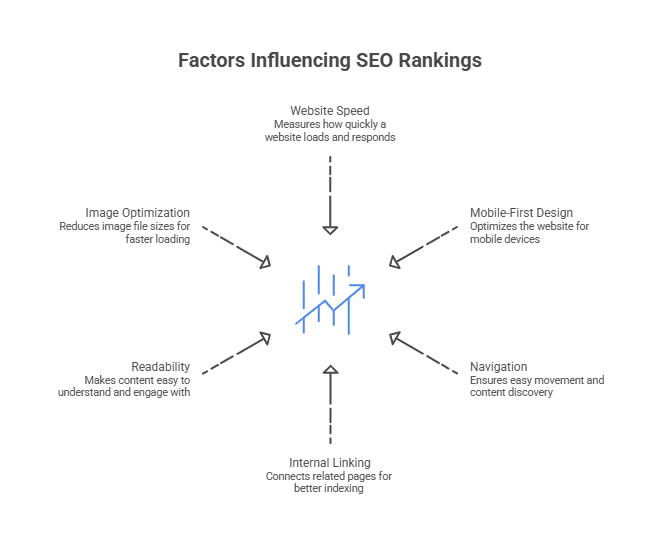
Website speed directly affects both rankings and sales. In fact, Google has officially been incorporating Core Web Vitals into its algorithm since 2021. Largest Contentful Paint (LCP) measures the main content load. Cumulative Layout Shift (CLS) checks for jumping content. Interaction to Next Paint (INP) tracks response time. All three matter in Core Web Vitals.
Mobile-first indexing and responsive design
Mobile-first design is a key ranking factor for Google SEO success. This principally revolves around responsive design, which adapts to any screen size automatically. Nowadays, failing to optimise for mobile means losing the majority of your potential audience.
Navigation and homepage structure
Clear, intuitive website navigation helps both users and search engine crawlers find content quickly. Furthermore, a well-structured homepage establishes a site's hierarchy and signals which pages are most important.
Internal linking and site architecture
Internal linking connects related pages and creates pathways for search engines to discover and index. Relatedly, a strong site architecture makes it easier for crawlers to understand topical relationships.
Readability and content layout
In practice, content that's easy to read keeps visitors engaged longer. Thereby, sending positive signals to search engines. Search engines can also better index well-structured content when ranking for relevant keywords and appearing in featured snippets.
Image optimisation and accessibility
Optimised images appreciably reduce page load times. This, in turn, results in better rankings. Accessible images also help your content reach users with disabilities. This consequently demonstrates compliance with web accessibility standards that search engines increasingly value.
How Poor Web Design Can Hurt SEO?
Poor web design can undermine one's SEO performance, often in ways that aren't instantly obvious. For instance:
Slow loading speeds and heavy design elements
Big videos and unoptimised images kill page speed. In fact, heavy animations make pages feel sluggish. Every extra second loses more visitors and slow sites often get punished in search results.
Confusing navigation and poor UX
Hidden menus frustrate everyone who visits. In many cases, users cannot find what they need quickly. Consequently, they leave and never come back. Google sees this as a negative signal and drops your rankings.
Hidden or inaccessible content
Content buried behind JavaScript-heavy interactions, hidden in non-crawlable formats, or placed in images without alt text remains invisible to search engines. Google can't index what it can't read.
Poor mobile usability
Non-responsive designs, tiny touch targets, and horizontal scrolling requirements create frustrating mobile experiences. Google often demotes sites with a poor mobile experience, even if your desktop version is perfect.
High bounce rates and low engagement
Bounce rate measures how quickly visitors exit one's website. High bounce rates signal low value to Google. Short visit times also hurt your rankings. Bad design often drives these poor metrics.
What Happens to SEO During a Website Redesign?
A website redesign can either significantly improve your SEO or devastatingly damage it. Common mistakes include changing URLs without redirects and hiding key pages in new navigation. Rankings can also drop because Google must 're-learn' or 're-process' your site.
Fortunately, redirects tell Google where old pages have moved. Preserving URL structures wherever possible minimises disruption. When you must change URLs, use 301 redirects for every single change. Afterwards, submit an updated sitemap to Google to expedite re-indexing.
Content preservation ensures you don't lose ranking power from pages that have accumulated authority over time.
How to redesign a website without losing SEO traffic?
Redesigning a website without losing SEO traffic requires methodical planning, execution, and monitoring. During this process, it's imperative to:
- Audit your current site before changing anything.
- List every URL that drives traffic to you.
- Keep their content and URLs when you can.
- Test everything on a staging site first.
- Launch changes slowly, not all at once.
Also read: Website Design Vs Rebranding.
Should You Hire One Agency for Both SEO and Web Design?
Yes, hiring one agency for both SEO and web design offers significant advantages, such as:
- Better collaboration between design and SEO teams.
- Consistent strategy across UX, content, and technical SEO.
- Faster project timelines and faster time-to-market.
- SEO built into design, not added as an afterthought.
- Single point of accountability.
Also read: 10 Tips on How to Choose a Web Design Company
Conclusion
SEO and web design work jointly to influence search engine rankings. They are two sides of the same coin—neither can succeed in isolation. As we have seen, design elements directly impact technical SEO factors that Google prioritises.
Retroactively adding SEO elements is far less efficient than building optimisation into the foundation. In fact, it often leads to costly fixes, missed opportunities, and rankings that struggle to recover.
When SEO and design collaborate from the start, this synergy drives higher rankings, attracts the right audience, and keeps visitors engaged longer. Thereby, converting them into loyal customers.
Ready to build a website that ranks well and converts visitors? Explore Bikebear's web design services along with powerful search marketing strategies that drive sustainable organic traffic and long-term growth for your business.