

Key Takeaways
- B2B and B2C websites differ because their buyers, decision-making processes, and conversion goals are completely different.
- B2B website design focuses on lead generation, trust-building, educational content, and supporting longer buying journeys.
- B2C websites prioritise fast navigation, emotional appeal, product discovery, and seamless online purchases.
- A strong B2B website should include case studies, industry-specific pages, demos, consultations, and clear business-focused messaging.
- Effective B2C websites rely heavily on mobile-first design, social proof, promotions, and frictionless checkout experiences.
- Designing a website around customer intent is essential because B2B buyers seek information and trust, while B2C buyers seek convenience and emotional connection.
Introduction
B2B and B2C websites nowadays act as the primary touchpoint for many modern customers. However, B2B buyers and B2C buyers think radically differently.
For many B2C brands, a website is effectively the store. It showcases products, builds trust with reviews and clear information, and enables fast, convenient purchases. For B2B companies, the website plays a mission-critical role in longer, more complex buying cycles.
B2B vs B2C Website: What Are the Biggest Differences?
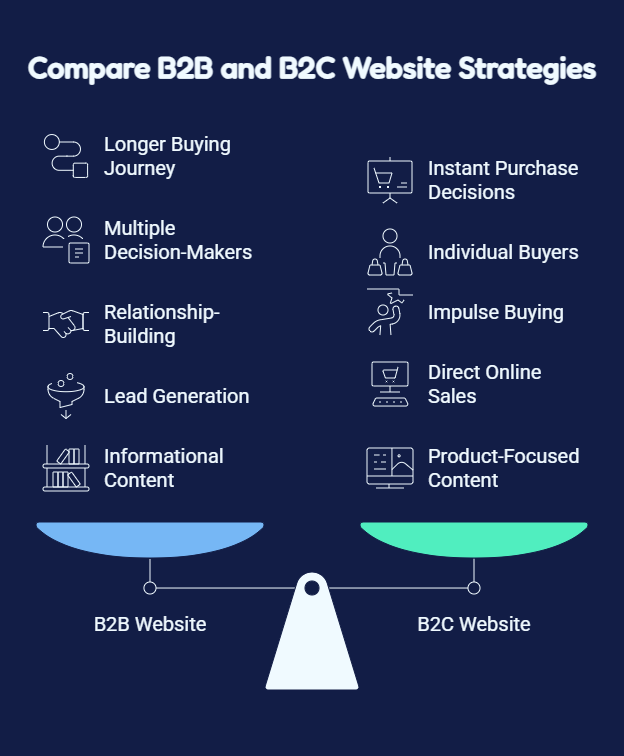
B2B and B2C websites both aim to drive business results. However, they do it in very different ways. This is because their audiences, buying processes, and decision dynamics aren't the same.
- Longer buying journey vs instant purchase decisions: B2B websites give detailed information for careful evaluation. B2C websites are optimised for fast browsing and quick checkout.
- Multiple decision-makers vs individual buyers: B2B sites must address the needs of different roles influencing the same purchase. B2C sites mainly persuade a single shopper.
- Relationship-building vs impulse buying: B2B websites emphasise trust, long-term value, and ongoing partnerships. B2C websites often encourage spontaneous purchases with promotions and scarcity messages.
- Lead generation vs direct online sales: B2B sites often aim to capture leads that will be followed up by sales teams. B2C sites usually focus on completing the transaction online.
- Informational content vs product-focused content: B2B websites prioritise educational resources to explain complex offerings. B2C websites highlight product-focused content to help shoppers choose and buy specific items.
What Are the Key Elements of a B2B Website Design?
B2B websites explain clearly what the company does while guiding visitors toward meaningful actions like demo requests or consultations. Here are the key elements that underpin this ethos:
Clear value proposition and business positioning
B2B website design should focus on educating multiple stakeholders, demonstrating expertise and providing detailed specifications about high-value purchases.
As such, it needs to be concise messaging, supported by brief proof points like key benefits, industries served, or logos of clients to position the business clearly in the visitor's mind.
Corporate Branding
Consistent corporate branding helps B2B companies look credible, memorable, and aligned with their target market. Consistent logos, colour palettes, typography, and imagery should reflect the company's personality and industry. To sustain a consistent brand presence, consider exploring Bikebear's branding services in Malaysia.
Trust-building through case studies, certifications, and testimonials
B2B deals often involve higher risk and long-term commitments. As such, buyers always look for evidence that a vendor can deliver. Case studies, industry certifications, awards, client logos, and testimonials all help reduce perceived risk.
Lead-focused CTAs for demos, consultations, and enquiries
A good B2B website is designed around clear calls-to-action that move visitors into the sales pipeline. Buttons and forms for booking demos, requesting consultations, and downloading resources should be prominent. Hence, the site steadily turns anonymous traffic into qualified leads.
Industry-specific solution pages
B2B buyers desire to see how a solution fits their specific context. Industry-focused pages with use cases and success stories help visitors feel that their unique challenges and regulatory requirements are understood.
Educational content and resources
B2B buyers often spend substantial time researching before talking to sales. Therefore, educational content is crucial to position the company as an expert and help prospects self-educate.
Corporate website lead generation strategy
A B2B website needs a deliberate corporate website lead generation strategy. It cannot rely only on visuals or design flair. When asking "Why is lead generation important for B2B websites?", the answer is simple. Without steady, high-quality leads from the website, even a great-looking site fails to support sales and growth.
Also read: Why Your Website Looks Great But Doesn't Generate Leads.
What Are the Key Elements of a B2C Website Design?
Effective B2C websites attract consumers and spark emotion whilst making it as easy as possible to discover products and complete purchases. Here are the key elements that underpin effective B2C design:
Emotion-driven and visually engaging design
B2C websites often lean heavily on visuals, colours, imagery, and layouts. This is principally to evoke an emotional connection so that users quickly develop trust and make a purchase.
Fast product discovery and simple navigation
Consumers want to find what they need in a few clicks. So, clear categories, powerful search, filters, and intuitive menus are essential. Good B2C navigation reduces effort, helping shoppers quickly move from the homepage to the exact product they need.
Promotions, offers, and urgency-driven CTAs
B2C websites often highlight promotions, discounts, bundles, and limited-time offers to encourage action. The idea is to nudge visitors toward making a purchase sooner rather than later.
Ecommerce-focused user experience
The entire B2C experience is designed around browsing, adding to cart, and checking out with as few obstacles as possible. So, elements like multiple payment options and a streamlined checkout flow are critical to reducing cart abandonment and increasing sales.
Also read: Ecommerce web design in 2026.
Social proof and customer reviews
B2C buyers rely heavily on seeing what other customers think. So, ratings, reviews, user photos, and testimonials are key for social proof to build confidence and reduce uncertainty.
Mobile-first shopping experience
Many consumers shop primarily on their phones. As such, B2C websites must maintain a mobile-first design. This ensures navigation, product viewing, and checkout feel just as smooth on a smartphone as on a desktop.
How Do You Design for Multiple Decision-Makers on a B2B Website?
A well-designed B2B website recognises that decisions are rarely made by multiple business stakeholders who all have different concerns. It needs to cater to all these stakeholders so they can confidently move the opportunity forward instead of stalling or abandoning it.
Why B2B buyers need more information before converting
B2B purchasing is complex. The tech director needs technical specs. The CFO needs ROI numbers. The CEO needs strategic alignment. One website must satisfy all of them.
Creating pages for technical, operational, and business stakeholders
Different stakeholders read different pages. Your website should guide each to what they need.
Using case studies, ROI messaging, and proof points effectively
Case studies are your secret weapon. Show real companies, real results, real outcomes. Proof points build credibility. Awards, certifications, big-name clients, media mentions—all show you're real.
What Pages Does a B2B Website Need That B2C Does Not?
- Solution and service pages: These pages explain complex offerings in detail. They explain how different solutions or services address specific business problems.
- Industry-specific pages: These pages use tailored language, use cases, and compliance details that resonate with niche audiences.
- Case studies and success stories: These pages show real results from real customers. Include metrics and outcomes.
- Resource centres, whitepapers, and insights: These pages provide free, valuable content and educational materials to build authority.
- Consultation or RFQ pages: Pages for booking consultations and requesting quotes (RFQs) capture complex requirements before a sale.
What Makes a Good B2B Website?
- Clear business-focused messaging: It communicates with direct language tailored to business outcomes.
- Strong credibility and authority signals: Exploits client logos, certifications, and testimonials to build trust with risk-aware buyers.
- Easy navigation for multiple decision-makers: It guides different people to different information.
- Informational content that supports longer buying cycles: Provides blogs, guides, FAQs, and resources that help buyers research thoroughly over time.
- Conversion-focused enquiry and demo CTAs: It features clear, prominent calls-to-action for enquiries, demos, and consultations that turn interest into qualified leads.
What Makes a Good B2C Website?
- Fast and intuitive user experience: It features pages that load quickly, and navigation feels effortless.
- Visually appealing product presentation: It presents high-quality images, videos, and clear descriptions, helping users imagine ownership.
- Personalised shopping experiences: Recommendations, tailored content, and relevant offers based on behaviour or preferences make the site feel more helpful and increase the chances of a purchase.
- Quick purchase and checkout process: Minimal steps, guest checkout, clear pricing, and convenient payment options reduce friction and prevent users from abandoning their carts.
- Strong branding and emotional appeal: Consistent visuals, tone, and storytelling create an emotional connection, making the brand memorable and encouraging customers to return and stay loyal.
B2B vs. B2C Website Best Practices
Audiences think, search, and decide very differently. So, a "one-size-fits-all" approach almost always wastes traffic and hurts conversions.
For B2B web design:
- Keep messaging clear and outcome-focused: Highlight business results, efficiency gains, and ROI in simple language.
- Use strong trust and authority signals: Showcase certifications, client logos, testimonials, and case studies to reduce perceived risk.
- Add lead generation CTAs across the website: Place clear buttons and forms for demos, consultations, and enquiries on key pages.
- Optimise pages for SEO and search intent: Align your content with the terms your ideal clients search for and follow best practices for SEO ranking.
For B2C web design:
- Simplify navigation and checkout flows: Make buying as easy as possible, in as few steps as possible.
- Use high-quality visuals and product imagery: Use photos from multiple angles and lifestyle imagery to help customers quickly understand features and benefits.
- Create urgency through offers and promotions: Utilise limited-time deals and discounts to encourage faster purchase decisions.
- Optimise for mobile shopping experiences: Ensure the site loads fast and works smoothly on smartphones to support on-the-go shoppers.
Also read: Web Design Trends 2026.
Common Mistakes in B2B and B2C Web Design
- Treating all audiences the same: A one-size-fits-all design or messaging ignores the significant differences between B2B and B2C buyers.
- Overcomplicated navigation and messaging: Visitors should understand your site in ten seconds. Confusing navigation loses sales.
- Weak CTAs and conversion paths: Action-oriented CTAs always convert better.
- Ignoring mobile user experience: Half your traffic is mobile. A bad mobile site loses money.
- No clear value proposition: Visitors shouldn't have to guess what you do.
Final Remarks
Overall, B2B and B2C websites are fundamentally different. They serve different buyer profiles and behaviours. In fact, all successful websites are built around customer intent.
B2B buyers need education, trust, and clear business value. B2C buyers need emotion, visual appeal, and easy shopping. Confusion between B2B and B2C costs money. A B2B site designed like B2C loses leads. A B2C site designed like B2B loses sales.
Is your website designed for your business model? Let Bike Bear build a website that matches your business and your buyers.
Overall, B2B and B2C websites shape brand perception and support lead generation. Thereby, helping convert interest into revenue. This article seeks to deeply explore the distinctions between the two website verticals.