



Key Takeaways
- A school's website is the primary touchpoint for parents evaluating enrolment, making mobile-first design and fast load times non-negotiable in 2026.
- Schools that meet WCAG 2.2 Level AA accessibility standards build trust with diverse communities and reduce legal risk.
- AI chatbots, personalised content paths, and virtual campus tours are becoming baseline expectations for competitive schools.
- Local SEO, schema markup, and Google Business Profile optimisation are the most overlooked growth levers for school websites in Malaysia and Southeast Asia.
Attracting new students for the next semester is a vital part of managing a successful school. One way of doing so is to build a creative school website design that pulls people’s attention and shows off your school’s best features in a clear, concise and even fun way.
This guide provides essential tips and practices for creating the best design for a school website.
Who This Guide Is For
This guide provides essential tips and practices for creating the best design for a school website. It is intended for school administrators, marketing officers, and decision-makers at private and international schools, particularly in Malaysia and Southeast Asia. Whether you're researching how to design a website for school or evaluating web design services for schools, this is your starting point.
Why is a Website Needed For a School?
First impressions of your school no longer happen at the front door. Instead, like nearly everything else today, parents and prospective students alike will be searching online for places of learning that appeal to them. As such, schools are expected to have a well-designed, user-friendly website that accurately conveys their vision, goals, and curriculum.
Benefits of Good Web Design For Schools
Here are some of the advantages that excellent website design for schools can provide to your institution:
- Creates brand awareness: Like any organisation, schools need a recognisable brand identity. Having an outstanding website is one way of creating and spreading awareness of your school brand. A school website can be decorated with its logo, colours, and slogan to help increase the academy’s recognisability.
- Builds trust: An organisation with a website is seen as credible and trustworthy. Effective web design can help strengthen trust between your school and the community, especially since many parents today are incredibly tech-savvy and will form their opinions based on first impressions of your website.
- Improves visibility: By using search engine optimisation (SEO), you can stand above the competition and gain the attention of prospective students. As your search rankings increase, so does your school’s visibility, in turn, improving your website’s traffic and brand recognition.
- Easy information access: A website provides the perfect platform to display crucial information such as courses offered, admission procedures, staff directories, calendar events and even lunch menus.
- Showcasing school achievements: A good website allows schools to highlight their student’s accomplishments, academic programs, and extracurricular activities, promoting pride and school spirit.
- Improved communication and engagement: Clear navigation and organised content make it easy for parents, students, and staff to quickly find important information, while interactive features like event calendars, newsletters, and online portals enhance engagement between the school and its community. An informative yet easy-to-navigate site will be seen as being run by a professional, well-organised school.
- Increases enrolment: An attractive and informative website can effectively showcase the school’s strengths and programs, encouraging more applications.
- Admissions can be processed online. As you begin the next school year, your staff will be busy processing new applications. Going online can streamline this tedious process and provide information about the admission requirements, deadlines, and application review process.
- Easy maintenance: A thoughtfully designed website is easier to manage and update, ensuring that the latest information is always available and accurate.
Best Practices For Good School Website Design
Now that you know the importance of having a website for schools, here are some tips and practices you should follow in order to create the best school website design:
Create a “Useful Homepage”
Your school website's homepage is the first thing visitors see. While looks do matter, you must also make your homepage 'useful' — in the sense that visitors will be able to get to the page they want with a few simple clicks and as little scrolling and manoeuvring as possible.
- Please keep it simple: Sometimes, simple is the best. Schools often cram too much information into a single page. The best homepages are easy to read and quickly guide visitors to relevant content.
- School overview: A brief introduction to the school, including its mission, values, and key offerings.
- Clear navigation: Easy-to-use menus that guide users to important sections like admissions, academic programs, and contact information.
- News and event calendar: Your homepage should display an event calendar, which showcases current or upcoming events and keeps parents, students, and staff informed.
- Call to Action: These are buttons placed prominently in strategic parts of your site. Button titles such as "Apply Now," "Schedule a Tour," or "Contact Us" will better engage prospective families.
- Social media integration: Linking your school's social media accounts to the site will foster a sense of community and keep users connected.
Use a Mobile-Friendly Design
Most parents or prospective students will likely read about your school on a smartphone or tablet. As such, you should ensure that your school's website is easily accessible to a wide variety of devices. In 2026, mobile-first design means building for phones first and scaling up to desktop. Google's mobile-first indexing means your mobile site determines your search rankings.
A good mobile-friendly design should include automatic resizing and reformatting, fast load times and the ability to be shared on social media such as Facebook.
Meet Website Accessibility Requirements
Everyone deserves equal access to education, and that goes for your website’s accessibility. By adhering to accessibility standards, you ensure your website can be easily navigated by everyone in your school community or beyond, regardless of their abilities.
WCAG 2.2 Level AA is now the recommended baseline for school websites globally, with new criteria covering focus visibility, mobile touch targets, and cognitive accessibility.
Here are some examples of acceptable school website accessibility features:
- Providing alternative text descriptions for non-text features such as images or videos.
- Ensuring all functionality is available from the keyboard.
- sing a sufficient contrast ratio between foreground and background colours.
- Minimum touch target sizes of 24x24 CSS pixels for mobile users.
- Clear focus indicators on all interactive elements.
For Malaysian schools, accessibility also means multilingual design, properly structured multilingual pages for English, Bahasa Malaysia, Mandarin, and Tamil speakers, not just a Google Translate widget.
Data protection matters too; Malaysia's PDPA 2024 amendments (effective June 2025) require data breach notification within 72 hours and increased non-compliance penalties to RM1 million. Schools collecting data online need compliant privacy notices and consent mechanisms.
Provide Easy Navigation
Intuitive, well-organised navigation is a crucial element of any good school web design. The 7-Link rule is a standard method of organising your website’s navigation — sorting out navigation and sub-navigation with seven links. Visitors are more likely to decide if they see seven or fewer links to choose from. Anything more can be overwhelming. Be sure to include a homepage link to ensure that visitors can return as quickly as possible.
Streamline Popular Pages
Be sure to focus on your school website’s most popular pages and ensure they are as user-friendly as possible. Here are some of the more popular pages on any school website :
- Calendar: Make sure your school calendar is easily accessible and contains relevant, accurate information on upcoming events.
- Contact directory: Make sure your school's contact information is easy to find and access.
- Student and parent portals: These are direct links to online portals where students and parents can log in for grades, assignments, and other resources.
- Teacher pages: Links to teacher pages should be easy to find and access, enabling parents and students to see all the information they need on teachers.
Include High-Quality Images
Professionally shot images of your students, staff, and facilities will help visually sell how good your school is to parents and prospective students. Putting them on a slider (or rotation) is a good way to show off those images without cluttering the pages.
2026 Trends Reshaping School Website Design
If you're looking for school website design ideas and school website design inspiration, these are the trends defining the best school website design right now:
- AI chatbots for admissions: Handle routine questions — fees, deadlines, programme details — around the clock.
- Virtual campus tours: 360-degree photos or short video walkthroughs are now the baseline for relocating families.
- Personalised content paths: Serve customised journeys based on whether visitors are prospective parents, current families, or students.
- Video-first storytelling: Authentic footage outperforms stock imagery every time.
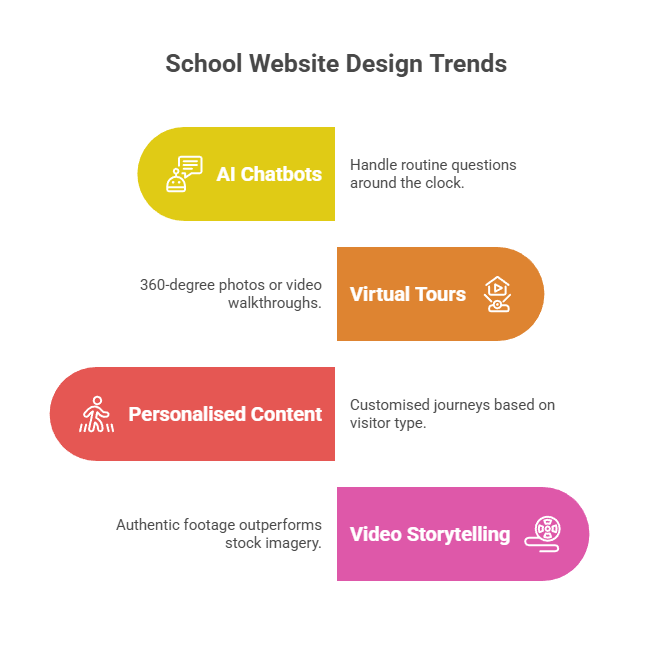
Image: School Website Design Trends
5 Common School Website Design Mistakes
Even schools with good intentions get website design for schools wrong. These are the most common issues — and they're all fixable:
- Cramming everything onto the homepage. Prioritise three to five key messages; link deeper content on interior pages.
- Ignoring mobile performance. A site that takes eight seconds to load on a phone loses parents before they see a word.
- Letting content go stale. A calendar from last term or a staff directory with departed teachers signals neglect.
- Weak calls-to-action. If your admissions page lacks a prominent "Apply Now" button, you're hoping parents figure out the next step themselves.
- Treating accessibility as optional. Inaccessible websites exclude members of your own community.
Practical SEO for School Websites
Parents who are relocating or exploring alternatives start with a search engine. If your school doesn't appear, those families go to competitors.
Local SEO: Claim and optimise your school's Google Business Profile. Encourage parents to leave reviews. Ensure your school's name, address, and phone number are identical across your website, Google, social media, and directories.
On-page SEO: Give every page a unique title tag (under 60 characters) and meta description (under 155 characters). Add EducationalOrganization schema markup for rich snippets in search results.
Content that ranks: Blogs about what parents actually ask, like "What's the difference between IB and IGCSE?" "How do I prepare my child for international school?" These queries bring families into your ecosystem early.
Explore more about Bikebear’s SEO services here!
When to Invest in School Website Design Services
Not every school needs a new website right now. But these signals mean it's time:
- Enrolment enquiries have dropped, and you can't pinpoint why.
- Your site isn't mobile-responsive.
- The website is more than four years old.
- Simple content updates require a developer.
- You've received accessibility complaints or failed an audit.
- Competitors have visibly upgraded their sites.
Why You Should Hire a School Website Design Agency
If you’re strapped for the skills, expertise, or time needed to create a good school website design, then consider hiring web design services for schools. A school website design agency offers professional teams that can utilise their experience and knowledge to design a school website suited to your needs and preferences.
When evaluating agencies, look for education sector experience, brand strategy capability, SEO awareness, and a portfolio of school sites that are fast, accessible, and ranking.
In addition to saving time and money on website design for schools, a school website design service will also provide SEO optimisation services and other crucial elements of web design necessary for maintaining and updating your website in the long run.
Explore Bikebear’s web design services here!
Conclusion
Schools, like any other organisation today, must use the power of the Internet to succeed in a digital world. First impressions are now occurring on your school’s homepage rather than behind its front gates. Thus, by providing an easy, well-organised, and intuitive online user experience to parents and prospective students, you demonstrate your school brand’s dedication to organised education, putting it at the top of their lists to enrol.
BikeBear’s Web Design For Architects
If your school needs a professional web designer who offers excellent web design for education, then look no further than BikeBear! We have a whole team of web design professionals dedicated to creating the best website for your school.
Our integrated approach covers brand strategy, web design, accessibility, and SEO — so every part of your digital presence works together.
Contact us now, and we’ll get started on the best design for your school website!